Skip to Main Content
Accommodations, Neuroincluison, and AI Audits: What's Next For Disability Inclusion in EMEA
disability inclusion, disability inclusion in EMEA, disability inclusion in Europe, workplace accommodations, accessibility, digital accessibility, European Accessibility Act, EAA compliance, neuroinclusion, neurodiversity in the workplace, AI in hiring, AI bias, accessible AI, cognitive accessibility, accessible procurement, inclusive design, disability employment, Disability Index, Disability:IN EMEA Summit, future of work


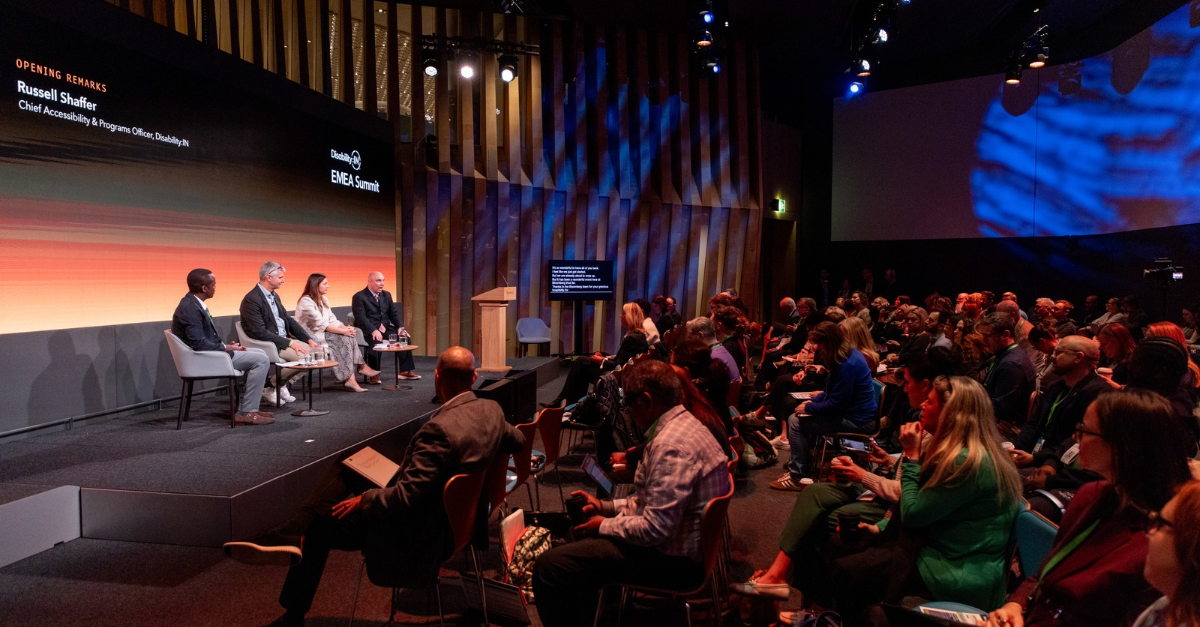
On 5 and 6 November 2026, Disability:IN brought together leaders from 103 companies across 16 countries at Bloomberg's London offices for our Europe, Middle East and Africa (EMEA) Summit.
Disability:IN President and CEO Jill Houghton opened with a simple idea: the future of work is not something that happens to us. It is something we design. And right now, it is being designed faster than at any point in our working lives. AI is changing how people apply for jobs, how they are hired, how teams collaborate and how decisions get made. Each of those design choices shapes who gets to be part of that future.
Over a day and a half, the conversations in the room gave a clear read on where companies across the region are putting their attention. Here is what we heard, and what it means for your business.
Where EMEA stands today
The 2026 Disability Index, drew 627 submissions from 421 organizations in 45 countries. EMEA accounted for submissions from 22 countries.
The average EMEA score is 51.4 out of 76, right at the boundary between Established and Advanced proficiency.
- Where the region is strongest: benefits, career development and culture, along with public reporting and supplier commitments.
- Where the biggest gaps remain: accommodation systems, accessible recruiting and customer-facing digital accessibility.
The strengths show that disability inclusion is becoming part of how organizations attract, support and develop talent, rather than sitting solely within an inclusion program. The foundations are in place, but the next frontier of this work is to embed disability and accessibility into the systems, strategies and technologies that run the business.
Five priorities shaping the region
1. AI across the employee lifecycle: lean in on learning, slow down on hiring
Companies are moving quickly with AI in onboarding and development. Examples shared at the Summit included role-based AI assistants, an onboarding agent paired with a human mentor for each new hire's first 120 days, and AI coaching for questions employees may not want to ask their manager.
Hiring is where leaders urged caution. From research gathered through our INsight Lab, candidates with chronic, physical or sensory disabilities were screened out of one AI interview workflow at a rate of about 80%. In a survey of roughly 100 young disabled professionals from our NextGen Leaders program, 56% said they would prefer not to do an AI interview, while 99% were comfortable with a human-led one.
Leading companies are testing AI screening tools for disparate impact before they go live, offering a human-led alternative scored the same way, and keeping a person accountable for every hiring decision.
2. From accommodations to accessibility by default
Everway research found that 78% of young people with non-apparent disabilities do not disclose at work. That makes request-based accommodation systems, the region's biggest Index gap, an incomplete answer on their own.
Companies shared how they are shifting. One global asset manager replaced multiple request routes with a single form focused on needs rather than diagnoses. A global software company funds accommodations centrally, so access does not depend on a manager's budget. Others are switching on supports such as captions, meeting summaries, text-to-speech and task breakdown by default, so employees get what they need without having to ask.
3. The European Accessibility Act: compliance is the starting point
The European Accessibility Act (EAA) has applied since 28 June 2025, and every EU country studied has written it into national law. Scope, timelines and enforcement still vary by country, and formal penalties have barely started. The pressure is arriving first from customers, competitors and civil society.
Leaders at the Summit stressed that a company's headquarters location does not exempt it if it offers covered consumer products or services in Europe meaning that the enforcement has strong implications for companies operating around the globe.
4. Accessible growth: customers, places and procurement
Disabled customers judge the whole journey- but much of the friction goes unseen, because people often leave rather than escalate or seek support.
Companies are responding by walking customer journeys with disabled customers, treating cognitive accessibility as a design requirement and adding accessibility to procurement scoring and supplier contracts. On the built environment, one life sciences company has assessed more than 200 buildings, and a financial data company is rolling out a building accessibility dashboard.
5. Managers and leaders: where disability inclusion succeeds or stalls
Managers shape the daily experience. Leaders decide whether it feels safe to be open. Our Momentum at Work research with LinkedIn found that only 2% of employees moved into a bigger role with their current employer in a year, while 6.3% left to find one. Among neurodivergent employees, 76% say a good relationship with their manager is critical to their success.
Companies are giving managers practical tools: how to respond to a disclosure, where the accommodations process lives and simple habits such as opening meetings with, "Does anyone have any access needs that we can support today?"
What it adds up to
Across sessions, four tests came up again and again:
- Design it in. Build accessibility into systems from the start instead of retrofitting.
- Make it available to everyone. Switch supports on by default, and treat repeated requests as barriers to remove.
- Prove it, don't claim it. Trust comes from data, documentation and testing with disabled people.
- Keep humans at the helm. Use AI to reduce friction, and keep people accountable for the decisions that matter most.
Put the Summit to work on Monday
Jill asked every attendee to carry one question through the Summit: what can I take back and put to work on Monday?
Our new action guide, IN Practice: Shaping the Future of Work, by Design, is built to answer it. It turns the Summit's eight themes into practical next steps, including:
- A "where to start this quarter" table for nine business functions, from the executive team to procurement
- An AI in hiring checklist
- A Universal Support Menu of low-cost AI supports that help specific groups and most employees
- A 30-minute team protocol for deciding where AI helps and where a person decides
- A five-point briefing on the EAA for legal, compliance and risk teams
Download the IN Practice EMEA Summit action guide
Keep the momentum going
Registration for the 2027 Disability Index opens in January. For the first time, the Index will look at how companies approach AI, product design, neuroinclusion and compensation, the same topics that shaped this Summit.