Skip to Main Content
New Disability:IN Initiative Aims to Close the Gap Between Veteran Talent and Business Hiring
A new study from Disability:IN finds that veterans with service-connected disabilities often fall between the two, and that employers who bring them together deliver sustainable long-term results for veterans, their business, and their brand.


Most veterans with service-connected disabilities have never asked their employer for an accommodation: 65% compared with 36% of civilians with disabilities. A new Disability:IN study asks why and what employers are missing.
[ARLINGTON, VIRGINIA] — November, 10 2026 – Veteran hiring and disability inclusion have long run on separate tracks inside companies. A new study from Disability:IN finds that veterans with service-connected disabilities often fall between the two, and that employers who bring them together deliver sustainable long-term results for veterans, their business, and their brand.
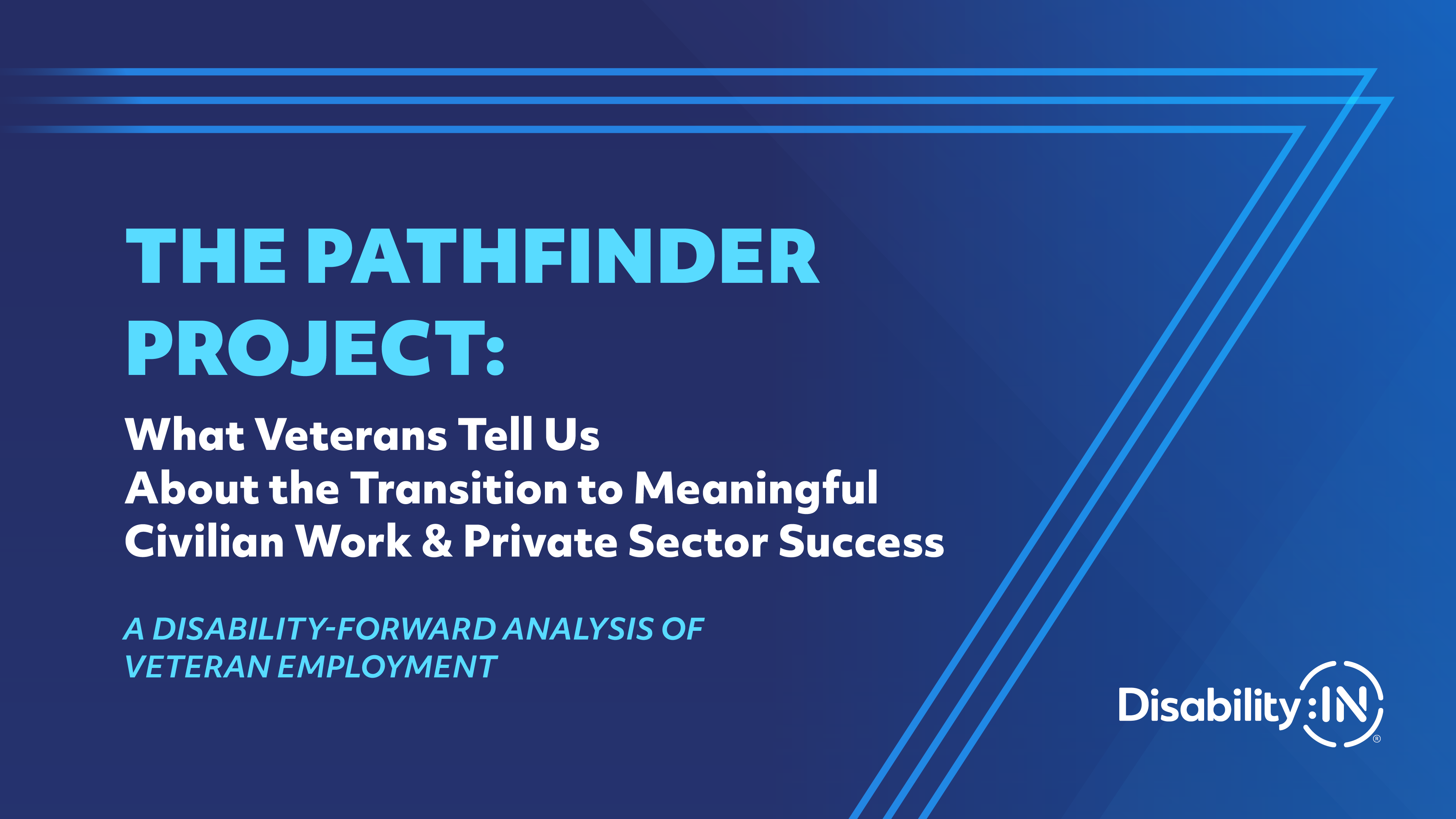
The Pathfinder Project takes its name from the military's Pathfinders, elite specialists who deploy ahead of their units to make the way safe for those who follow. In this study, the “Pathfinders” are disabled veterans who have charted their own path to establish successful corporate careers. Through in-depth interviews, their experiences reveal trends that point to what employers can do differently across recruiting, onboarding, workplace culture, and career development.
According to the research, more than 60% of veterans said they never or rarely talk about their disabilities at work and 65% of veterans with disabilities said they had never requested a workplace accommodation. Drawing on in-depth interviews with disabled veterans and a survey of more than 200 veterans and civilians with and without disabilities, the findings point toward a new opportunity for business: integrate veteran talent and disability inclusion strategies to strengthen both.
"Veteran inclusion and disability inclusion have too often lived in separate silos," said Jill Houghton, President & CEO, Disability:IN. "The Pathfinder Project shows what's possible when we bring them together to create enormous synergies across any industry. Veterans with service-connected disabilities bring leadership, accountability, and a mission focus that strengthens any business. Those companies that embrace this imperative will take a giant step forward in achieving their talent priorities both short and long term.”

Key Findings
- Leadership drives satisfaction. Veterans reporting high organizational culture and job satisfaction were especially likely (88%) to say their leadership skills are used at work. Recreating military culture is not the answer: Job satisfaction showed only a weak link to military-style workplaces, reflecting both the value and confidence that military personally have in their transferable skills, including leadership.
- Peers outperform formal programs. 72% of veterans agreed that informal support from military colleagues was more useful than formal transition programs. Guidance from military peers scored 3.64 out of 5 versus 2.25 for other formal transition programming, which validates the impact that peer-to-peer engagement has across multiple industries and business environments.
- Disability often stays private. Over 60% of disabled veterans almost never refer to themselves as disabled veterans at work. They rated veteran identity as shaping their approach to work far more than disability identity (3.94 vs. 2.44 out of 5).
- Few request accommodations. 65% of veterans with disabilities have never requested a workplace accommodation compared with 36% of civilians with disabilities, revealing a gap in receiving support that could help them thrive at work. Many rely instead on informal flexibility from managers, such as time for VA appointments.
- Getting in the door is harder. Disabled veterans reported similar difficulty as civilians with disabilities in securing interviews, pointing to challenges beyond translating military experience into civilian hiring language and a chronic challenge for veterans spanning decades.
The report also offers actionable steps for employers: train managers on disability inclusion as part of veteran hiring, take on more of the work of translating military skills, include veterans in hiring, and connect veteran and disability employee resource groups (ERGs).
The study was led by Disability:IN researcher Louis Olander, Ph.D., Director of Research & Veterans Initiatives and a veteran of the war in Iraq. Through his work at Disability:IN, he realized a critical piece of the disability narrative was missing, one that showcased the story of resilience and success among disabled veterans.
"As a veteran, I know the instinct to drive on and keep quiet about what you're carrying," said Olander. "What struck me in this research was how much we disabled veterans rely on one another and what an invaluable asset that is as we navigate our careers following our service to our country. Companies that embed that kind of peer support in how they translate military experience for candidates and current employees alike will pave the way for many more to follow.”
"Veterans with service-connected disabilities bring the skills every employer needs, yet too many face barriers to quality careers when transitioning to the civilian workforce," said Michelle Armstrong, President of the Ares Charitable Foundation, which funds the initiative. "Supporting the Pathfinder Project allows us to meaningfully honor their service through tangible career opportunities and better position them for on-the-job success and economic mobility."
"As a service-disabled veteran, I know firsthand how important it is for companies to recognize the experience and skills veterans bring to the workplace,” said Lance Dorsey, U.S. Air Force Veteran and Executive Director, Global Responsible Sourcing at Sony Pictures Entertainment. “Through Sony Pictures’ involvement with Disability:IN, I’ve had the opportunity to bring my own experience to this important initiative, and I’m proud to work at a company where hiring and development opportunities help create pathways to successful civilian careers."
From Findings to Framework
The second phase of the Pathfinder Project will incorporate the study’s findings into practice at scale in real workplaces. Disability:IN will partner with a select group of employers that want to align their veteran and disability efforts to develop a playbook for supporting veterans with disabilities across the full career cycle. Companies interested to participate in this phase of the project are encouraged to express interest here. [LINK]
About the Study
The Pathfinder Project included in-depth interviews with 15 disabled veterans who have found success in corporate America and a survey of more than 200 disabled and non-disabled veterans and civilians among Disability:IN corporate partners and their contacts. The Disability:IN research team designed and conducted the study, with guidance throughout from an advisory group of disabled veterans. The study was made possible with support from the Ares Charitable Foundation.
The full report is available at DisabilityIN.org/Resources/Veteran-at-Work.
About Disability:IN
Disability:IN is the leading nonprofit resource for business disability inclusion worldwide. With the world's leading companies as partners, Disability:IN drives progress through initiatives, tools, and expertise that deliver long-term business impact. Learn more at DisabilityIN.org.
About the Ares Charitable Foundation
The Ares Charitable Foundation (the “Ares Foundation”) envisions a world in which people have access to the knowledge, resources and opportunities needed to help chart pathways to self-sufficiency and drive strong economies. Established in 2021 as a 501(c)(3) qualifying organization sponsored by Ares Management Corporation (“Ares” or the “Firm”), we strive to advance economic mobility by helping people prepare and reskill for quality jobs, launch and scale businesses, and build personal financial knowledge. We execute our philanthropy with the same rigor, discipline and entrepreneurial spirit that Ares brings to its investment activities and business operations. Furthermore, we aim to ensure that these efforts help demonstrate Ares’ core values—to be collaborative, responsible, entrepreneurial, self-aware and trustworthy—in action.